UW Mechanical Engineering
Joy Ge
Selected Work
Featured Projects
Robot-DJ
0 human inputPersonal Project
Built an autonomous Meca500 DJ system that analyzes music, plans transitions, synchronizes tempo with closed-loop control, and operates a physical controller.

Automation Cell Design
180 Parts/minATS Corporation
Designed the precision mechanical architecture for a 13-station automation cell assembling a wearable insulin-device subassembly at 180 parts per minute.
Digital Painting to Robot Pipeline
40+ Paintings analyzedAcrylic Robotics
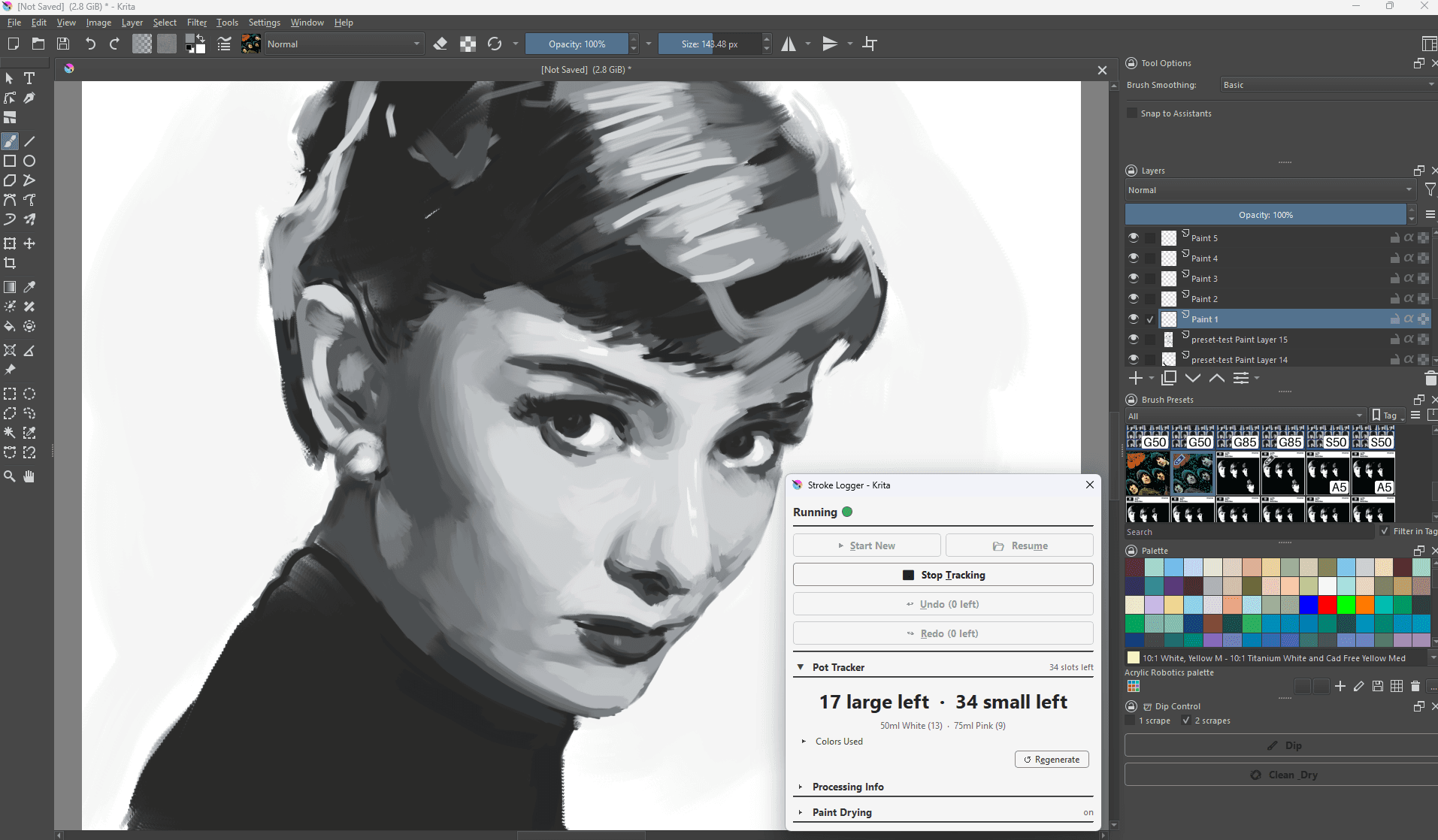
Built a production pipeline that converts artist input from Krita, an open-source digital painting application, into validated and recoverable robot painting motions.
Personal Project
Robot-DJ
Built an autonomous Meca500 DJ system that analyzes music, plans transitions, synchronizes tempo with closed-loop control, and operates a physical controller.
Challenge
Build a robot DJ that can sequence an uploaded playlist without manual input, reach small knobs, faders, and buttons safely, and keep transitions synchronized despite timing error in physical button presses.
Approach
Analyzed tracks with Librosa and NumPy, then used an LLM to select transition timing, controls, and motion sequence. Implemented a closed-loop PID controller to nudge track tempo into alignment and continuously correct synchronization error. Simulated reach and collision constraints in RoboDK, taught control poses, and designed a three-piece EOAT with two TPU contact parts and a 3D-printed holder for knobs and faders.
Impact
Validated autonomous transitions across a 10-song playlist with no manual input. A recorded test held synchronization error to 4 ms, with no audible mismatch in tracks.
ATS Corporation
Automation Cell Design
Designed the precision mechanical architecture for a 13-station automation cell assembling a wearable insulin-device subassembly at 180 parts per minute.
Challenge
Design a 13-station cell capable of forming, loading, and assembling metal, spring, and polymer components under 5 mm while meeting a 180-part-per-minute production requirement and micron-level positioning targets.
Approach
Owned the mechanical design of one pallet with two nests, two stackable locating tray types, conveyor integration, and the mechanisms and tooling used across 13 stations. Managed motion, cycle-time, tolerance, access, and serviceability trade-offs while coordinating conveyor requirements and quotations with suppliers. Used Rockwell Motion Analyzer to size motors, drives, and ball screws for acceleration and a 15+ year service life.
Impact
Designed station operations to place and form components to 50 μm accuracy with an 80 μm pallet-on-shuttle stack-up. Used nonlinear FEA at a 240-part-per-minute requirement to confirm rate capability for a critical mechanism, and presented a reusable tray-feeding architecture to the Director of Innovation as a standard approach for future proposals.
Acrylic Robotics
Digital Painting to Robot Pipeline
Built a production pipeline that converts artist input from Krita, an open-source digital painting application, into validated and recoverable robot painting motions.
Challenge
Krita gives artists control over digital brushwork, but it does not naturally represent physical limits such as paint depletion, brush cleaning, robot reach, waypoint density, velocity, or inverse-kinematic feasibility. The challenge was to expose those constraints early without disrupting the artist’s workflow or allowing the canvas and robot instruction data to diverge.
Approach
Built and shipped a Krita plugin that logs stroke waypoints, pressure, rotation, colour, opacity, and artist-controlled dipping and cleaning actions to CSV. Updated the processing and robot-control repositories to filter infeasible paths, transform strokes into canvas coordinates, and produce kinematically safe robot instructions. Added autosave, crash recovery, undo-aware logging, stroke buffering, tool restrictions, and GitHub Actions checks for the Railway deployment.
Impact
Analyzed robot-computer logs from more than 20 paintings before production changes and more than 20 afterward, reducing logged painting failures from approximately 30% to 2%. Automated brush switching and recovery safeguards saved roughly one hour per eight-hour digital painting and protected artists from losing up to a full day of work. Recreating the same bear artwork in Krita required approximately one-third as many strokes as the previous Illustrator workflow.
There's more
10 More Projects
From DJ-ing robots to painting ones
About me
hey!
I love sappy textbook dedications, penguins, and robotics built for a better human experience. Reach out to build something together!
Say helloBackground
I'm a 2nd year mech-eng student at UWaterloo. I've worked on autonomous cucumber harvest robots, high-speed production cells, and robots that paint.
Experience
ATS Corporation
Mechanical Designer Co-op
Sep – Dec 2025 · Cambridge, ON
Acrylic Robotics
Robotics Engineer Intern
May - Aug 2026 · Montreal
Education
University of Waterloo
BASc Mechanical Engineering
Expected 2029
Tools